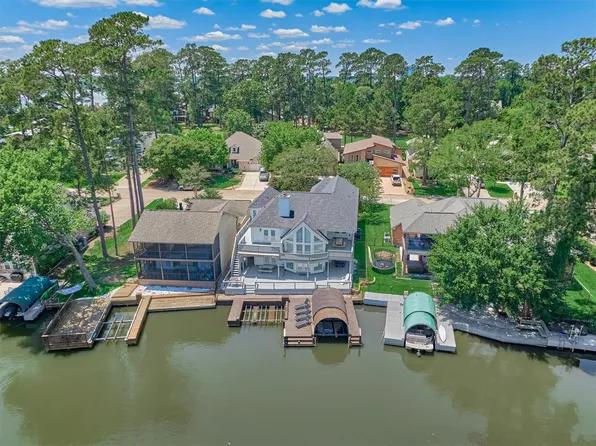
Your Lake Conroe Listing Photos Show Water at the Bulkhead—But What Will Buyers See When They Arrive?
The Lake Didn't Move—So Why Does Your Waterfront Look Completely Different Today?
The seller pulls up an old photo.
Beautiful.
Blue water reaches almost to the top of the bulkhead.
Boat sitting perfectly in the lift.
Dock surrounded by water.
Sunset reflecting across the lake.
Then the buyer arrives.
They walk into the backyard.
The shoreline looks different.
The water is lower.
More bulkhead is exposed.
Maybe more shoreline is visible.
The buyer looks at the listing photo.
Then looks at the lake.
Then asks:
“What happened?”
Nothing necessarily happened to the property.
They are looking at a body of water whose level can change.
And that means sellers of Lake Conroe waterfront homes need to market something ordinary residential sellers rarely think about:
The water itself changes the presentation of the property.
Start by Understanding Current Lake Conditions
Before photography:
Know what buyers will actually see.
Look at:
Water position.
Dock.
Boat lift.
Bulkhead.
Shoreline.
Visible lakebed where applicable.
Do not rely only on photos from:
Last year.
Three summers ago.
The day you bought the house.
Historical Photos Can Still Be Useful
Maybe you have a spectacular photo showing:
Higher water.
Sunset.
Boat in the slip.
Full shoreline.
It may help demonstrate the property in another season or condition.
But it should not mislead buyers about current conditions.
Current Photos Should Lead
Your primary listing photography should represent the property buyers will actually visit.
Do Not Digitally Raise the Water
Do not:
Extend water toward the bulkhead.
Remove exposed shoreline.
Deepen the color to hide shallow areas.
Alter dock-water relationships.
Waterfront buyers care about these details.
Lake Level and Water Depth Are Different Questions
Buyer asks:
“How deep is the water at the dock?”
Seller says:
“The lake is at normal level.”
That does not answer the question.
Water depth at a particular dock depends on the specific property and current conditions.
Never Guess Water Depth
Do not say:
“It's probably six feet.”
If depth is important:
Use reliable measurements and explain when they were taken.
Add Context to Measurements
Better:
[date]
when appropriate and accurate.
Do Not Guarantee Boat Access
A buyer may own:
Wake boat.
Pontoon.
Fishing boat.
Sailboat.
Other watercraft.
Different boats have different requirements.
Avoid:
“Any boat can get in here.”
Ask Buyers to Verify Their Specific Needs
They should evaluate:
Draft.
Lift capacity.
Water depth.
Canal/channel access where applicable.
Bridge clearance where relevant.
Other conditions affecting their watercraft.
The Boat Lift Needs Its Own Preparation
Before listing:
Test it.
Inspect visible components.
Clean the area.
Remove unnecessary clutter.
Know the Lift Capacity
If documented:
Provide it.
Do not guess based on:
“We had a big boat on it.”
Lift Capacity Does Not Mean Every Boat Fits
Buyer must consider:
Weight.
Hull.
Dimensions.
Lift configuration.
Water depth.
Keep Lift Documentation
If available:
Installation paperwork.
Service records.
Motor replacement.
Cable work.
Capacity information.
Photograph the Dock From Multiple Directions
Show:
Dock from house.
House from dock.
Dock from water where appropriate.
Lift.
Seating area.
Shoreline.
The buyer should understand how everything connects.
Dock Condition Can Affect the Entire Waterfront Impression
Look at:
Deck boards.
Railings.
Fasteners.
Roof if covered.
Electrical components.
Lighting.
Steps.
Ladders.
Loose Boards Should Not Be Ignored
A waterfront showing means buyers may:
Walk onto the dock.
Look closely.
Take photos.
Obvious maintenance problems become immediate concerns.
Electrical Systems Near Water Deserve Professional Attention
Do not DIY questionable:
Dock wiring.
Outlets.
Lighting.
Lift electrical components.
If there are concerns:
Use an appropriate professional.
Bulkhead Condition Matters
The bulkhead may be one of the first things an experienced waterfront buyer examines.
Look for visible:
Movement.
Damage.
Separation.
Erosion.
Deterioration.
Do Not Diagnose Bulkhead Life Yourself
Avoid:
“That bulkhead has another 30 years.”
unless supported by qualified evaluation.
Know When the Bulkhead Was Installed
If possible.
Also gather:
Repair records.
Replacement documentation.
Engineering or contractor records if applicable.
Exposed Bulkhead Can Actually Help Buyers Inspect It
Lower water may reveal portions normally less visible.
Do not panic.
Use it as an opportunity to understand condition.
Shoreline Appearance Changes
Depending on conditions, buyers may see:
More soil.
Vegetation.
Rock.
Bulkhead.
Beach-like area.
Do not assume that is permanent.
Do Not Call Temporary Shoreline “Private Beach”
Unless the property actually has an established beach feature.
Exposed lakebed created by changing water conditions is not automatically private usable land.
Property Boundaries Near Water Can Be Complicated
Do not assume:
“We own all the way to wherever the water is today.”
Waterfront boundaries and adjacent areas should be understood through appropriate documentation and professional guidance.
Surveys Are Particularly Important
Have available, when possible:
Current or existing survey.
Dock location information.
Property boundaries.
Easements.
Relevant waterfront improvements.
Do Not Draw Your Own Waterfront Property Line
Especially not on aerial photography.
If boundary graphics are used:
They should be based on reliable information.
Photography Timing Matters More on Waterfront Homes
A Lake Conroe property may photograph differently:
Morning.
Midday.
Sunset.
Cloudy day.
After heavy rain.
During different lake conditions.
Plan intentionally.
Sunset Is Not Always the Best Hero Shot
Beautiful?
Yes.
But if the house is completely dark:
Buyer cannot see the property.
Use sunset as supporting lifestyle imagery.
Daylight Should Explain the Waterfront
Buyers need to see:
Shoreline.
Dock.
Water.
Backyard.
House.
Drone Photography Can Be Extremely Valuable
Aerial imagery can show:
Open-water relationship.
Cove location.
Canal/channel position.
Neighboring waterfront.
Lot configuration.
But Drone Angles Can Mislead
A compressed perspective can make:
Water appear closer.
Cove appear wider.
Open water appear more immediate.
Use realistic imagery.
Show the Route From House to Water
Is it:
Flat lawn?
Steps?
Sloped yard?
Deck?
Path?
Buyers want to understand daily access.
Steep Waterfront Lots Need Accurate Presentation
Do not hide:
Stairs.
Elevation changes.
Retaining walls.
These may matter greatly to some buyers.
Outdoor Living Should Face the Lake
Stage:
Chairs.
Dining.
Lounges.
toward the water.
It sounds simple, but the view is part of what you are selling.
Clean the View From Inside
Windows overlooking the lake should be:
Clean.
Unobstructed.
Open.
Remove Heavy Window Coverings for Photography When Appropriate
The lake should be visible from:
Living room.
Kitchen.
Primary bedroom.
Breakfast area.
whenever those rooms actually have the view.
Do Not Exaggerate “Panoramic”
A narrow view between neighboring houses is not necessarily:
Panoramic lake view.
Use Accurate Waterfront Language
There is a meaningful difference between:
Open-water view.
Cove.
Canal.
Channel.
Waterfront.
Water view.
Water access.
Use terminology that accurately describes the property.
“Waterfront” and “Water View” Are Not the Same
A home that sees Lake Conroe across:
Street.
Common area.
Another property.
may offer a water view without being directly waterfront.
Accuracy protects credibility.
Buyers May Ask About Lake-Level History
Do not speculate.
Use authoritative historical information where relevant.
Avoid “The Lake Never Gets Low Here”
Conditions change.
Even if you have never personally experienced a particular condition:
That is not a guarantee.
Flooding and Lake Levels Are Not the Same Question
Buyer:
“If the lake rises, does the house flood?”
Do not answer based simply on:
Current shoreline.
They should evaluate:
Property-specific flood information.
Elevation.
History.
Insurance considerations.
Other relevant documentation.
Do Not Say “Never Flooded” Casually
Property history and seller disclosures should be handled accurately.
Insurance Questions Will Be Property-Specific
Waterfront buyers may ask about:
Flood insurance.
Homeowners insurance.
Dock coverage.
Boat lift coverage.
Do not quote future premiums from your own policy.
Your Premium Is Not Their Premium
Coverage.
Carrier.
Deductible.
Buyer profile.
Property changes.
can all affect cost.
Water-Level Changes Can Affect Buyer Emotion
Higher water may create:
Immediate waterfront drama.
Lower water may create:
Questions.
The answer is not hiding it.
The answer is:
Information.
Organized Sellers Create Confidence
Have:
Dock records.
Lift records.
Bulkhead records.
Survey.
Waterfront improvement records.
Relevant permits or approvals when available.
Do Not Assume Every Waterfront Improvement Was Automatically Allowed
If you inherited:
Dock.
Lift.
Bulkhead.
other structure,
find available documentation.
Pricing Needs to Reflect the Actual Waterfront Experience
Not every Lake Conroe waterfront property is equal.
Factors may include:
View.
Water depth.
Access.
Cove position.
Open water.
Dock.
Bulkhead.
Lot.
Home condition.
Outdoor living.
Do Not Price Solely by Waterfront Footage
More shoreline does not automatically mean:
Better property.
Quality of access and view can matter.
Compare Similar Waterfront Types
Open-water property versus:
Protected cove property
may attract different buyers.
Use meaningful comparables.
Use the “What Will Buyers See Today?” Test
Photograph it.
Use the “Can Their Boat Actually Work Here?” Test
Let them verify.
Use the “What Do We Know About the Dock?” Test
Gather records.
Use the “Current Fact or Future Promise?” Test
Avoid guarantees.
Lake Conroe Waterfront Seller Scorecard
Before listing, evaluate:
Current Lake Condition
Understood?
Photography
Current?
Historical Photos
Clearly contextualized?
Water Depth
No guesses?
Boat Access
No guarantees?
Dock
Clean?
Dock Boards
Safe and maintained?
Dock Electrical
Professionally addressed if needed?
Lift
Working?
Lift Capacity
Documented?
Lift Records
Available?
Bulkhead
Condition reviewed?
Bulkhead Records
Available?
Shoreline
Clean?
Property Boundary
Understood?
Survey
Available?
Backyard
Lake view open?
Windows
Clean?
Patio
Staged toward water?
Day Photography
Scheduled?
Sunset Photography
Considered?
Drone
Considered?
Waterfront Description
Accurate?
Flood Claims
No assumptions?
Pricing
Comparable waterfront type considered?
Final Thoughts
Lake Conroe is not a swimming pool.
The water does not sit at exactly the same position every day of every year.
And that means a waterfront seller has to market the property differently.
Before listing:
Look at current conditions.
Photograph what buyers will actually see.
Inspect the dock.
Test the lift.
Gather bulkhead records.
Find the survey.
Understand the waterfront configuration.
Clean the shoreline.
Open the lake views from inside.
Stage outdoor furniture toward the water.
Use daylight photography to explain the property.
Use sunset photography to create emotion.
Use drone imagery to show context.
Then be careful with your words.
Do not promise:
“Deep water forever.”
Do not guarantee:
“Any boat will work.”
Do not say:
“The lake never gets low here.”
Do not turn exposed shoreline into:
“Private beach.”
Instead:
Give buyers reliable information.
Because the strongest Lake Conroe listing is not the one that pretends the water never changes.
It is the one that helps the buyer understand exactly what they are buying:
The house.
The lot.
The shoreline.
The dock.
The view.
And the experience of living directly on Lake Conroe.
When those things are presented accurately, you do not need to manipulate the lake.
The waterfront can sell itself.
Frequently Asked Questions
Do Lake Conroe water levels change?
Yes. Lake levels can vary over time, which can change the appearance of shorelines, bulkheads, docks, and waterfront access.
Should I use older photos showing higher water?
Historical images can provide additional context, but current representative photography should lead the listing. Older photos should not create a misleading impression of present conditions.
Can I advertise the water depth at my dock?
If you have reliable current information, you can provide appropriate context. Avoid guessing or guaranteeing future depth because conditions can change.
Can I guarantee a buyer's boat will work with my dock?
No. Buyers should independently verify water depth, draft requirements, lift specifications, dimensions, access, and other factors for their particular watercraft.
Should I have my bulkhead inspected before selling?
It may be worthwhile when there are visible concerns, unknown age, significant deterioration, or when you want better information before buyer inspections.
Is exposed shoreline part of my property?
Do not assume property ownership based solely on the current waterline. Surveys and appropriate professional guidance should be used to understand waterfront boundaries.
Should I use drone photography?
Often yes. Drone photography can help buyers understand the home's relationship to the lake, cove, neighboring waterfront, and surrounding area.
Should I photograph the home at sunset?
Yes, when the property has an attractive sunset orientation or outdoor lighting. Keep strong daylight images as well so buyers can evaluate the waterfront clearly.
Does lower water mean the home has a flooding problem?
Not necessarily. Lake level, flood risk, drainage, elevation, and property history are separate considerations and should be evaluated using property-specific information.
What's the biggest takeaway?
When selling a Lake Conroe waterfront home, market the waterfront buyers can actually verify—not the perfect water conditions from your favorite photograph. Use current imagery, document the dock and bulkhead, avoid guarantees about water depth or boat access, and give buyers enough accurate information to understand the complete waterfront experience.